An early round of this season's turkeys, in the pen before processing. What makes a pastured bird worth ordering happened before it ever got here.
Not every turkey will sell whole, and none of them has to sell for less. A frozen turkey can wait for December or January and come back as cut-up turkey, ground turkey, sausage, stock, or broth, each priced for what it is.
The USDA's newest National Pasture-Raised Poultry Report came out September 25, 2026.
The next edition is due December 18, 2026, so these are the latest numbers we'll have before Thanksgiving.
What other farms got for a turkey
The same months, a year apart
Comparing this July to September with the same months a year ago:
- The lowest price reported for a whole turkey went from $4.50 a pound to $5.49, up $0.99 (+22%).
- The average went from $8.72 to $9.06, up $0.34 (+3.9%).
- The highest went from $14.99 to $15.90, up $0.91 (+6.1%).
The lowest price moved from 52% of the market average to 61%, meaning the bottom of the pastured market is moving closer to the center.
All five averages on that chart went up, half turkey most of all, from $8.00 to $10.16.
View the data table
| Item | Year | Low | Average | High |
|---|---|---|---|---|
| Whole turkey | 2025 | $4.50 | $8.72 | $14.99 |
| Whole turkey | 2026 | $5.49 | $9.06 | $15.90 |
| Half turkey | 2025 | $7.50 | $8.00 | $8.50 |
| Half turkey | 2026 | $8.50 | $10.16 | $11.99 |
| Ground turkey | 2025 | $10.00 | $13.20 | $18.99 |
| Ground turkey | 2026 | $10.00 | $14.22 | $20.00 |
| Turkey sausage | 2025 | $10.95 | $14.49 | $17.00 |
| Turkey sausage | 2026 | $9.00 | $14.60 | $19.00 |
| Breast, boneless | 2025 | $7.65 | $13.69 | $18.00 |
| Breast, boneless | 2026 | $7.65 | $14.79 | $19.50 |
For producers, these numbers should prompt a bigger question than simply, "What is everyone else charging?" In a report built from 67 premium sellers, the average whole turkey reached $9.06 a pound this year, while the lowest reported price increased 22%. If your retail price remains well below the premium-market average, take a hard look at whether you are capturing the full cost and value of raising that bird. Feed, labor, mortality, processing, overhead, marketing, and your own time all have to be paid for somewhere. Growing a premium product and then underpricing it does not create more value for the farm. It can simply mean the producer is absorbing costs the customer should be paying.
We have seen this firsthand. Three years ago, a partner farm was selling turkeys for $5.99 per pound. After allowing us to take over the marketing and sales ourselves, we moved to $8.00 per pound last year and $9.99 this year.
At $9.99, we are still only $0.93 above this year's reported premium-market average, and within the first 20 days of opening pre-orders, roughly one-third of our flock was already sold.
The lesson for us has been that pricing is not only about production costs. It is also about recognizing, communicating, and capturing the value you have created. A premium pastured bird still has to be marketed like a premium product. Sometimes the opportunity is not to work harder in the business, but to spend more time working on the business and asking whether your pricing, branding, and marketing reflect what your product is actually worth.
One bird, a year ago and now
Harder to shrug off than a price per pound
Put those prices on one 20-pound whole turkey.
- At the lowest price reported, it brings $109.80, up $19.80.
- At the average, it brings $181.20, up $6.80.
- At the highest, $318.00, up $18.20.
Now do the same math with your own price, this year's and last year's.
View the data table
| 20 lb bird | 2025 | 2026 |
|---|---|---|
| Lowest price reported | $90.00 | $109.80 |
| Average price | $174.40 | $181.20 |
| Highest price reported | $299.80 | $318.00 |
If you told your regulars a price months ago, keep your word to everyone who has already ordered. Put these numbers to work on the birds still open and on next year's price. A price can move in steps, and a step your regulars see coming on next year's pre-order form is easier for them to take than a jump.
Why you can ask more
What the report can't price for you
The report sorts farms by one thing: pasture. It doesn't break out regenerative practice, or organic practice, certified or not. It doesn't break out premium feed, or fresh fruit, or anything else a farm gives its flock on top of pasture, or even separate heritage birds from broad-breasted ones. Those are choices a farm makes on purpose and keeps making, every day the birds are out.
So the report can tell you what pastured birds bring. It can't tell you what the rest of your work is worth, because it never prices that on its own. And a farm doing any of it has no reason at all to set its price against a grocery-store turkey raised in a barn.
The report sorts farms by pasture and stops there. Everything you do beyond that point is what makes your farm, your product, and your story different. Do not let the value you worked so hard to create disappear when it comes time to set the price.
The rest of the turkey, in dollars
Every product has its own price
Thanksgiving does not have to be the deadline for making money on a turkey. If whole birds remain after the holiday, discounting them just to move them can give away the value you spent the season creating. Freeze the birds instead, keep a few whole for the Christmas customers who inevitably come looking, and plan to bring the rest back for further processing.
The calendar changing from Thanksgiving to Friday does not make the turkey worth less. It changes what form may be easiest to sell.
The cut prices show why further processing can protect value after Thanksgiving, but that does not mean every bird should simply be broken down into individual cuts. Keep some thighs, half turkeys, and breast meat in the freezer for customers who want them, especially when those cuts are priced to reflect their value. But for most farms, those cuts will not move as consistently through the year as ground turkey and sausage.
View the data table
| Item | Average price per pound |
|---|---|
| Breast tenderloin | $16.96 |
| Breast cutlets | $14.87 |
| Breast, boneless | $14.79 |
| Turkey sausage | $14.60 |
| Ground turkey | $14.22 |
| Breast, bone-in | $12.22 |
| Thighs | $11.01 |
| Half turkey | $10.16 |
| Whole turkey | $9.06 |
| Leg quarters | $8.31 |
| Drumsticks | $7.88 |
| Wings | $7.49 |
Keep enough thighs, halves, and breast meat to give customers variety, but do not let freezer space fill with slower-moving cuts simply because they carry a higher per-pound price. A higher price only creates value when the product actually sells.
That is why the majority of the meat from unsold whole birds may make more sense going into ground turkey and sausage. Those products are easier to sell year-round, create multiple SKUs and flavor options, and usually take up less freezer space pound for pound than storing a wide assortment of individual cuts. The goal is not to create the most cuts. It is to turn post-holiday inventory into the products most likely to keep moving.
A few premium cuts create variety. Ground and sausage create velocity.
Do not overlook the backs and bones either. They are not waste. Turkey stock and broth create additional SKUs from something that might otherwise sit in boxes in the freezer. Demand may be strongest heading into fall and Thanksgiving, but producing stock or broth during an off-season further-processing run turns bulky, low-value frozen inventory into a smaller, more valuable finished product that can wait on the shelf or in the freezer for the season when customers want it.
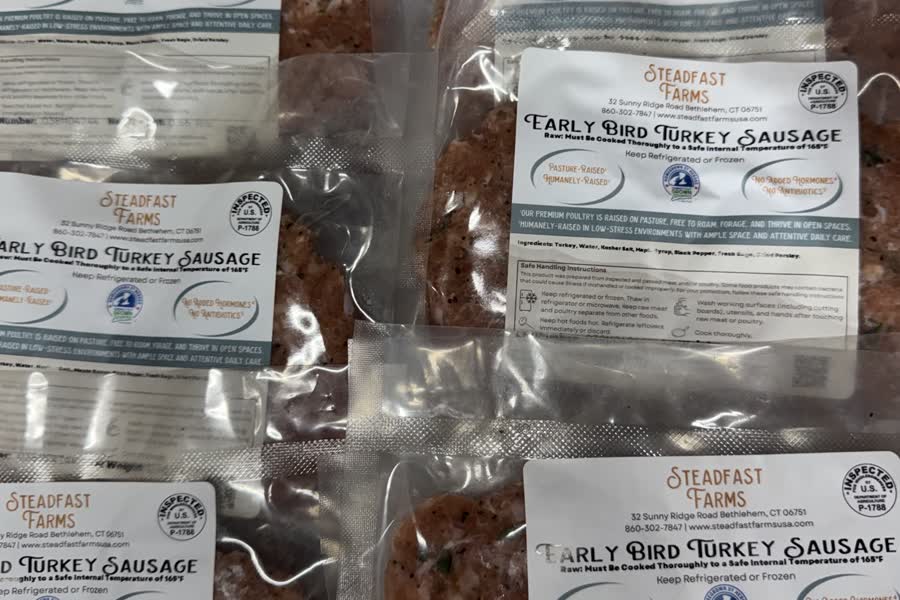
Early Bird Turkey Sausage is one example of what a bird can become after Thanksgiving. We retail these breakfast patties at $19.25 per pound. Further processing gives an unsold whole turkey another opportunity to earn throughout the year instead of forcing the farm to discount it at the end of one holiday.
A deposit on every bird
And no markdowns in Thanksgiving week
Turkeys tie up a farm's cash for months, and most farms don't have much to spare. So take a deposit on every whole bird that's pre-ordered. The deposit is what a farm has when someone backs out or doesn't show, as long as the terms are in writing: whether it's refundable, and until when.
Deposits in the report ran from $20 to $75 a bird. The average was $44, down from $50 a year ago, in a year when the bird's price went up. Don't follow it down. A deposit is there to cover what a farm loses when a bird goes unclaimed, and that loss grew with the bird's price, so set yours from what a no-show costs you.
Then there's Thanksgiving week itself. A markdown that week gives the people who waited a better deal than the people who ordered first. A turkey that doesn't sell whole doesn't need a discount. It needs a plan.
Plan for growth, not just Thanksgiving
The best time to make the plan was before the poults arrived. The next best time is now.
There is an old saying: the best time to plant a tree was 30 years ago. The next best time is today. Planning your turkey business works the same way. Ideally, before the poults arrive, you already know how many birds you expect to sell whole, how much growth you are planning for, and what the birds beyond that number will become. If you did not have that plan this year, that is not a reason to wait another season. What happened this Thanksgiving gives you the information to start building next year's plan now.
One of the lessons I carried with me from working in corporate food and retail is that selling out is not always the win it appears to be. If customers were still asking for something after you ran out, there were sales you could have made. At the other extreme, producing far more than you can sell and having no plan for what remains ties up cash, freezer space, and your labor. Neither extreme should be the goal.
Large food businesses think about this constantly. With an item that has to be pulled from frozen inventory and then sold within a fixed shelf life, the goal is not necessarily to pull exactly enough to finish the day with zero. A small amount left can be useful information. Sell out repeatedly, and demand may be telling you to increase the next pull. Waste very little while sales continue growing, and you may still have room to increase availability. The point is not the exact percentage. The point is that inventory, missed sales, and waste are all information you use to make the next decision.
Farms can use the same thinking with turkeys. If you sold every whole bird and still turned customers away, write that number down. Those weren't simply customers you could not help this year. They are part of the evidence you can use when deciding how many birds to raise next year.
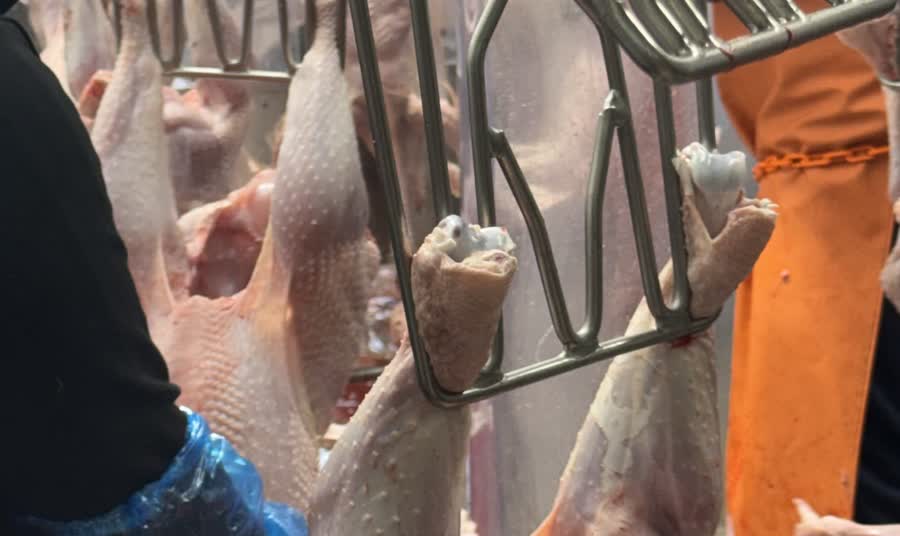
On the line at Steadfast Farms. A turkey that doesn't sell whole at Thanksgiving is still a good turkey in January, and what it becomes is up to the farm.
But I would not plan next year's flock around whole-bird sales alone. The cuts, ground turkey, sausage, stock, and broth we just discussed should become part of the plan too. If whole-bird sales grow, raise enough birds to support that growth and enough additional birds to intentionally feed the products that can earn revenue for the farm after Thanksgiving is over.
That is an important shift in thinking. The goal is no longer, "How many Thanksgiving turkeys can I sell?" It becomes, "How much turkey can my brand sell over the course of the year, and in what forms?"
Start with a count. Pick a date far enough ahead of slaughter that you still have time to market the remaining birds. Count the whole birds already spoken for through paid orders or deposits. Compare that with the number of birds you expect to process. Then separate the difference into two groups: birds you still want to sell whole and birds you are comfortable carrying into your post-Thanksgiving product plan.
If whole-bird orders are behind your goal, market them while there is still time to change the outcome. Start with past customers who have not ordered yet, then work through your email list, social media, farm store, markets, and other customer channels. Do not wait until the final days before Thanksgiving to discover that you have more whole birds than you intended.
And do not assume every remaining bird needs to be discounted. Thanksgiving ending does not erase the value in that turkey. Keep some whole birds available for Christmas. Every year there are customers who start looking for a turkey again in December, and having a small amount of planned inventory gives you another sales opportunity.
The rest can become the year-round side of the turkey business. Keep enough breasts, thighs, halves, or other premium cuts to give your product line variety, but think carefully about sales velocity. Ground turkey and sausage can move throughout the year, create additional SKUs and flavor options, and use freezer space more efficiently than carrying a freezer full of individual cuts that may move slowly.
Backs and bones deserve a plan too. Stock and broth turn something bulky and easy to overlook into another sellable product. Even if demand for turkey stock and broth is strongest heading into fall, processing those backs during an off-season production run can free freezer space, create another SKU, and put that inventory into a form that is more useful when the next selling season arrives.
This is also why further processing should be part of the plan before you need it. Know what products you want to make, minimum batch sizes, how many birds it takes to reach those batches, how much freezer space you need, and approximately when you want those birds processed. Then the birds left after Thanksgiving are not "leftovers." They are inventory already assigned to the next part of your sales plan.
That planning should roll directly into next year's flock size. Look at how many whole birds you sold, how many customers you could not serve, how quickly the remaining products moved, and what you wish you had more of. Then grow deliberately. Maybe that means 10% more birds next year. Maybe it means 25% more. The right number is different for every farm. What matters is that growth comes from what your sales are telling you, not from guessing.
There is still real opportunity in premium turkey. The work is not only raising a better bird. It is building a business that captures the value of that bird in every form it can take. Know your costs, price for the value you create, build demand for your brand, and plan enough production to give that demand somewhere to grow.
An extra turkey with no plan is excess inventory. An extra turkey with a destination is production for another SKU.
A quick note on feed and diesel
For next season's planning
The Bureau of Labor Statistics price index for chicken and turkey feed was up 10% in August 2026 on a year earlier, with corn up 16%.
Diesel in New England has risen from about $3.96 per gallon a year ago to about $6.51 now, an increase of $2.55 per gallon, or about 64%.
For next season, those increases are a reminder to build budgets with higher input costs in mind and review pricing early. If feed, fuel, labor, processing, and other expenses continue to rise, holding retail prices flat can quickly shrink the margin needed to make the flock profitable.
The Call
Price the extras from what turkey products sell for
Price your ground turkey and turkey sausage from what those products sell for, in dollars, not from your whole-bird price. This year ground turkey ran from $10.00 to $20.00 a pound and averaged $14.22, and turkey sausage ran from $9.00 to $19.00 and averaged $14.60. Start where your own market puts you in those ranges.
Plan them now. Work out what one extra bird brings at your prices once the processing charge comes off. Then decide how many extra birds become ground turkey or sausage and how many stay whole to sell frozen later, and write it down before the first one goes in the freezer.
What to do this week
While there's still time to change the outcome
Every price in that report was set by a farmer deciding what their work was worth. This week, make that decision on purpose.
Put your bird next to the market. Price a 20-pound turkey at your own price per pound and set it beside $109.80, $181.20 and $318.00. Then write down two numbers: your price for any birds still open this year, and the pre-order price you will stand behind next year.
Protect the birds already spoken for. Take a deposit on every whole bird that's pre-ordered, with the terms in writing. A deposit turns a maybe into a bird you can count, and it means a customer's change of plans isn't paid for by your farm.
Give every extra bird a destination. Decide now which birds stay whole for Christmas, which become ground turkey and sausage, and what each one will sell for. Put it on paper while you are calm, not the Wednesday before Thanksgiving.
You already did the hard part
You raised these birds on pasture through a full season of weather, feed bills and early mornings. The hard part is behind you. What's left is making sure your price, your plan and your story carry all of that to the customer.
Steadfast Farms is a USDA-inspected poultry plant in Bethlehem, Connecticut, working with farms across New England. We have watched what happens when a farm prices, plans and markets its birds like the premium product they are, and we would be glad to help you build that plan.
Email service@steadfastfarms.com or call (860) 302-7847.
Sources & method
- USDA Agricultural Marketing Service, National Pasture Raised Poultry Report, 2026 Q3 (July to September 2026), released September 25, 2026, compared with the same report for 2025 Q3 (July to September 2025). Direct-to-consumer prices by cut from 67 pastured producers nationwide, plus one aggregated state report, with the lowest, average and highest price for each item. The next edition is due December 18, 2026.
- The per-bird figures price a 20-pound bird at each price per pound. Deposits are priced by the bird; every other price is per pound.
- U.S. Bureau of Labor Statistics, producer price indexes for chicken and turkey feed and for corn, August 2026 against the same month a year earlier. The latest month is preliminary and can be revised.
- U.S. Energy Information Administration, weekly retail on-highway diesel prices for New England, week of September 28, 2026, against the same week a year earlier.
- The partner farm's prices and pre-order pace, and the Early Bird retail price, are Steadfast Farms' own figures.