Steadfast Farms' line of stocks and broths. Each product represents an opportunity to make more of the poultry we've raised.
Every flock represents months of hard work and investment. Making the most of it means recognizing the value in every part of the bird.
Raising poultry takes months of planning, investment, and hard work. While whole birds and popular cuts often receive the most attention, backs, frames, necks, and other parts have value too. Some can be sold directly to customers, while others can be turned into stock or broth. Understanding the options helps you determine which products make the most sense for your farm and your customers.
To explore those opportunities, we examined USDA-reported prices for poultry parts and bone broth alongside our own research into what farms are charging for stock, broth, and bone broth. Together, the findings offer useful insight into how these products are valued and what producers should consider before adding them to their lineup.
What Are Poultry Backs and Bones Worth?
A look at reported direct-to-consumer prices for poultry parts
The USDA's National Pasture Raised Poultry Report for July to September 2026, released September 25, 2026, reports direct-to-consumer prices from 67 pastured farms across the country.
The USDA's July through September 2026 report shows that chicken backs and frames averaged $4.64 per pound, while turkey backs and frames averaged $5.24. Both increased from the same period in 2025. These figures are a useful reminder that products sometimes treated as byproducts can have real retail value. Necks, feet, and other poultry parts also represent potential sales opportunities for farms with customers interested in them.
View the data table
| Item | Average price per pound |
|---|---|
| Chicken feet | $7.26 |
| Pet grind, with bones | $6.85 |
| Turkey necks | $5.51 |
| Chicken necks | $5.26 |
| Turkey backs and frames | $5.24 |
| Chicken backs and frames | $4.64 |
At Steadfast Farms, we retail our chicken and turkey backs for $5.00 per pound. Selling them raw is one option, but converting them into stock creates another. Before deciding which approach offers the better return, producers need to consider the value of the raw product, the amount of stock it can produce, the additional processing costs, and the price customers are willing to pay.
For example, if a farm has 50 pounds of backs available, selling them raw at $5 per pound would represent $250 in potential gross revenue if every pound sells. Turning those backs into stock could create another product to offer, but the farm would need to compare the finished yield, processing costs, and expected sales before knowing which option provides a better return.
The goal isn't necessarily to turn every back into stock. It's to understand which use delivers the best return for your farm.
Stock, broth, and bone broth
Three products, not three names for one
Stock, broth, and bone broth are often discussed interchangeably, but they can serve different purposes in the kitchen and appeal to different customers. Understanding those differences helps producers decide what to make, how to market it, and where it belongs in their product lineup.
- Stock is generally made using poultry bones, backs, and frames. It is typically used as a cooking base for soups, sauces, gravies, and other recipes. At Steadfast, our stock is unsalted, allowing customers to season their dishes as they choose.
- Broth is generally made with meatier poultry parts, creating a more pronounced poultry flavor. It is often seasoned and can be used as a cooking ingredient or enjoyed on its own. Our chicken broth is lightly seasoned and designed to be ready to use.
- Bone broth is typically marketed as a rich, collagen-containing product made using bones and connective tissue. Recipes and preparation methods vary considerably, so producers should evaluate the finished product and its intended customer rather than relying on the name alone.
At Steadfast Farms, we offer value-added processing services that allow producers to develop stock and broth from their own poultry. Stock can be made from their backs and frames, while broth can be produced using meatier parts or stewing hens. This gives farms an opportunity to expand their product offerings without investing in the equipment and facilities needed to produce these items themselves.
Making stock or broth gives you another product to sell, but how you position it determines whether customers recognize its value. A quart of stock intended for cooking serves a different purpose than a ready-to-use broth, and those differences should be reflected in how you describe, market, and price each product. Understanding what other farms charge is a useful place to start.
Understanding the Market for Stock and Broth
What reported prices reveal, and what they don't
USDA-reported chicken bone broth prices increased between the third quarters of 2025 and 2026. The average rose from $14.13 to $15.04 per quart, while the highest reported price climbed from $25.22 to $36.24. The difference between the average and the upper end of the market is worth examining, particularly for producers developing premium products or evaluating their current pricing.
These figures provide a useful reference point, but they don't tell the whole story behind each product. Differences in farming practices, ingredients, production methods, packaging, and customer markets can all influence price. Producers should use reported averages as context, not as a substitute for evaluating the value of their own products.
View the data table
| Item | Year | Low | Average | High |
|---|---|---|---|---|
| Chicken bone broth | 2025 | $5.75 | $14.13 | $25.22 |
| Chicken bone broth | 2026 | $5.95 | $15.04 | $36.24 |
| Turkey bone broth | 2025 | $6.75 | $11.03 | $16.99 |
| Turkey bone broth | 2026 | $6.75 | $10.73 | $13.00 |
To look beyond the USDA's bone broth data, we also reviewed publicly available prices for stock, broth, and bone broth sold directly by farms. On October 28, 2026, we identified 36 priced listings from 31 farms, allowing us to compare how these products are presented and priced across different markets.
Our survey found a wide range of listed prices across all three product categories. Stock had a median price of $10 per quart, compared with $14 for broth and $13 for bone broth. New England producers were represented at different price points within those ranges, reinforcing that there isn't one standard price every farm should follow. Product characteristics, customer demand, and individual business costs all play a role in determining an appropriate selling price.
View the data table
| Sold as | Listings | Lowest | Median | Highest |
|---|---|---|---|---|
| stock | 12 | $5.14 | $10.00 | $24.00 |
| broth | 5 | $12.00 | $14.00 | $22.83 |
| bone broth | 19 | $6.25 | $13.00 | $25.98 |
What Are You Really Selling?
The difference between stock, broth, and bone broth isn't just a matter of terminology. Each can serve a different purpose, appeal to a different customer, and carry different expectations.
For producers, clearly communicating those differences is an important part of developing a successful product. Customers should understand what they're buying, how they can use it, and what makes it worth the price.
A well-positioned product starts with an accurate description of what it offers, not simply a name that sounds more valuable.
Is Turkey Stock Being Undervalued?
What the reported pricing differences could mean for producers
The USDA data revealed an interesting contrast. While the reported average price of turkey backs and frames increased to $5.24 per pound, the average reported price for turkey bone broth declined from $11.03 to $10.73 per quart.
Over the same period, chicken bone broth averaged $15.04 per quart, considerably more than turkey bone broth.
Several factors could contribute to this difference, including production costs, customer preferences, and seasonal demand. While the data doesn't establish why turkey bone broth has a lower reported average price than chicken bone broth, it raises a question worth considering: Are producers evaluating their turkey products independently, or simply following the prices already established in their market?
Our survey offered another perspective on chicken and turkey pricing. Of the three farms offering both products, none listed turkey at a higher price. At Steadfast, we take a different approach with our stock, pricing chicken and turkey as distinct products. Our chicken stock retails for $12.00 per quart, while our turkey stock sells for $13.25. We evaluate each product independently, considering production costs, availability, and how it fits into our overall offerings. This approach works for our customers, but it's one example of how producers can evaluate their own pricing.
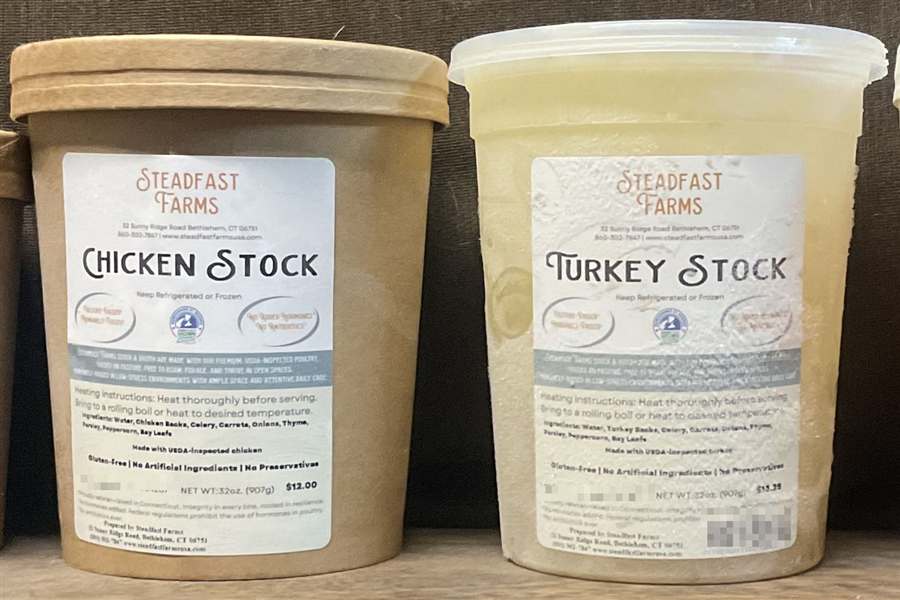
Two stocks, two pricing decisions. At Steadfast Farms, we evaluate our chicken and turkey stock as distinct products rather than assuming they should carry the same price.
Chicken and turkey stock may serve similar purposes, but that doesn't mean they should automatically carry the same price.
Making the Most of a Seasonal Product
For farms raising turkeys primarily for Thanksgiving, stock and broth offer an opportunity to extend sales beyond the holiday. Planning these products ahead of processing allows producers to consider when to offer them, how to introduce them to customers, and whether they fit into a broader winter sales strategy.
- Seasonal availability. When turkey products are available for only part of the year, let customers know. Clear communication about when products will be available can encourage customers to plan ahead.
- Advance orders. Offering preorders for turkey stock or broth may help producers estimate demand before committing to production.
- Holiday bundles. Stock and broth can complement other farm products in packages designed for holiday cooking, gifting, or winter meal preparation.
- Explain the Difference. If turkey stock requires different inputs, production costs, or sourcing considerations than chicken stock, explain those differences and consider whether they support a different selling price.
The goal is to build on the natural seasonality of your farm, giving customers a clear reason to purchase these products when they're available.
The Opportunity Doesn't End at Thanksgiving
Give customers reasons to keep cooking with your products all winter
Thanksgiving may drive turkey sales in November, but stock and broth have uses throughout the winter. With the right planning, producers can continue offering these products long after the holiday rush.
- December: Holiday gravies, sauces, stuffing, and winter meals
- January: Soups, stews, and convenient family dinners
- February: Comfort foods, gumbo, and hearty cold-weather recipes
Putting the Numbers to Work on Your Farm
Three decisions to make before your next processing appointment
The goal isn't to charge the highest price. It's to understand your costs, recognize your product's value, and find a price your market will support.
1. Evaluate what you have. Start with your available inventory and what your upcoming flocks will produce. Consider how much you can realistically sell as raw parts and how much might be better suited for stock or broth.
2. Compare your options. Look at the price you could receive for the parts themselves, the finished yield of a value-added product, and the additional costs involved in producing it. Consider customer demand before committing to a new product.
3. Build a plan for selling it. Think about how your customers will use the finished product, what they may be willing to pay, and when they're most likely to purchase it. Seasonal promotions, preorders, and bundled offerings may all be useful depending on your market.
Let's Make More of Your Flock
You've invested months into raising your flock. Our goal is to help you make the most of that work, whether that means preparing poultry parts for direct sale or turning them into stock and broth for your customers.
As Connecticut's only USDA-inspected poultry slaughter and processing facility, we work with producers across the Northeast to explore processing and value-added opportunities that fit their operations. Reach out to our team to discuss what's possible for your farm.
Email service@steadfastfarms.com or call (860) 302-7847.
Sources & method
- USDA Agricultural Marketing Service, National Pasture Raised Poultry Report, 2026 Q3 (July to September 2026), released September 25, 2026, compared with the same report for 2025 Q3 (July to September 2025). Direct-to-consumer prices by item from 67 pastured producers across the country plus one aggregated state report, with the lowest, average, and highest price for each. Bone broth is priced by the quart, every other item by the pound. No new quarter has been released since; the next is due December 18, 2026. The full report is at www.ams.usda.gov/mnreports/pymnprpoultry.pdf.
- Steadfast Farms survey of farm stock and broth prices, October 28, 2026: the web stores and public posts of farms selling poultry stock, broth, or bone broth direct, 36 priced listings from 31 farms across the U.S., filed under the name each farm sells it by. Prices are the listed price scaled to a quart; a sale price is replaced by the regular price. This was a selected sample of publicly available listings, not a statistically representative survey. Farms are not named.
- Steadfast Farms' own retail prices for backs, chicken stock, and turkey stock. The raw-backs example is illustrative gross revenue at our retail price, not profit.