Know the HACCP Plan
Know the HACCP Plan
The Steadfast HACCP Program is not one plan for every product. It is built in sections because the product, process, and hazards are different across the work being done.
It's not just a set of critical control points (CCPs).
It starts with the product being slaughtered or processed, and then identifies hazards and establishes controls to eliminate or bring those hazards into acceptable limits.
Built by
Hazard Analysis
The Steadfast HACCP Program is not one plan for every product. It is built in four HACCP plans because different products and processes have different hazards.
The HACCP Program lays out HACCP Slaughter, HACCP Voluntary Slaughter, HACCP Processing “Raw Intact,” and HACCP Processing “Raw Non-Intact.”
You have to know which HACCP Plan applies to the work in front of you.
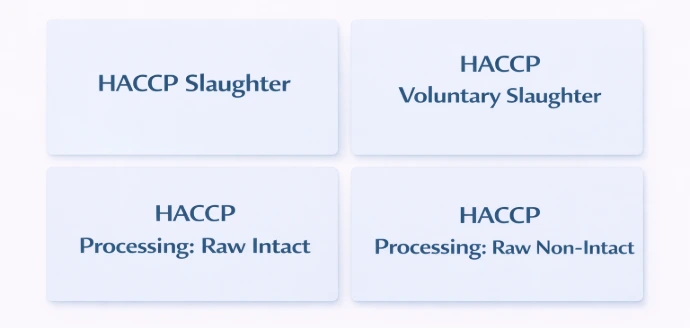
Choosing the Right Plan
HACCP Slaughter
Covers Poultry Species as defined by the USDA
- Chicken, Turkey, Duck, Geese
- Whole Birds and Giblets
HACCP Voluntary Slaughter
Covers Non-amenable Species as defined by the USDA that are not covered by the mandatory inspection requirements of the Federal Meat Inspection Act (FMIA) or Poultry Products Inspection Act (PPIA).
- Pheasant, Chukar, Quail
- Whole Birds and Giblets
HACCP Processing: Raw Intact
- Covers the further processing of Joint Parted or marinated pieces of a poultry or non-amenable species.
HACCP Processing: Raw Non-Intact
- Covers the further processing of deboning, grinding, sausage mixing, and casing of a poultry or non-amenable species.
Standardized Layouts
Each of the 4 HACCP plans follows the same documentation flow.
- Flow Chart
Product Description
- Name
- Packing
- Where it will be sold
- Shelf Life and Temperature
- Shipping
- Customers
Products and Ingredients
- Meat and Byproducts
- Non-Meat Food Ingredients
- Binders
- Spices / Flavorings
- Allergen Ingredients
- Preservatives / Acidifiers
- Non-meat Ingredients / Products
- Critical Control Point Cards
- Hazard Analysis Step by Step
Flow Charts
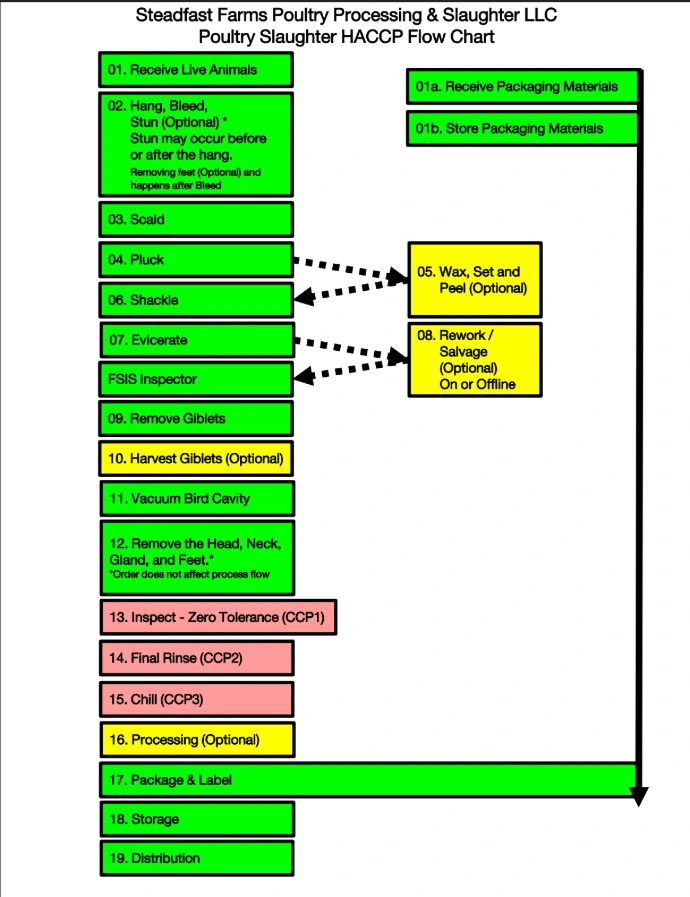
Flow charts map the process from step to step. They show the order of the work and give the HACCP plan its backbone. The hazard analysis follows that flow. The CCPs, where applicable, are tied to that flow. If you do not know where you are in the flow chart, you do not know where you are in the plan.
The flow chart is the roadmap of the HACCP plan.
Flow charts also train order of operations. They help employees understand where the product is in the process and what comes next.
Every process step on the flow chart must be reflected in the hazard analysis. When building, updating, or reviewing a HACCP plan, the flow chart is one of the starting points. That sequence matches the Codex structure already referenced in your training and the way your master document presents flow charts before hazard analysis.
Hazard Analysis
Hazard analysis is the proactive and systematic part of the HACCP plan that evaluates each process step for physical, chemical, and biological hazards. It identifies the food safety risk, explains the justification, lists the measures, and determines whether the step is or is not a Critical Control Point.
This is where the logic of the HACCP plan lives. It shows why product is controlled against adulteration, what work is being done at that step, and when control is handled through an SOP or later process step instead of a CCP.
To understand the HACCP plan,
You must understand the hazard analysis.
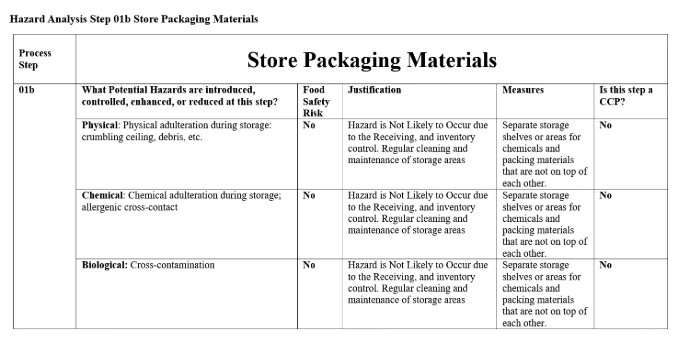
Each hazard analysis card evaluates one process step. It identifies the potential physical, chemical, and biological hazards introduced, controlled, enhanced, or reduced at that step. It then identifies whether those hazards are a food safety risk, gives the justification, lists the measures, and states whether the step is a CCP.
Critical Control Points
A Critical Control Point (CCP) is a process step where control can be applied to prevent, eliminate, or reduce a food safety hazard to an acceptable level.
When a step is a CCP, the HACCP plan does not leave control to assumption. It sets a defined standard that must be met and proven with records.
A CCP summary card shows what that control is. It identifies the hazard, the critical limit, what is monitored, how it is monitored, how often monitoring happens, who performs it, what corrective action is required, how verification is performed, and what records prove control.
The hazard analysis determines whether a step becomes a CCP. When a step is critical, the CCP summary card shows exactly how the room holds that step under control.
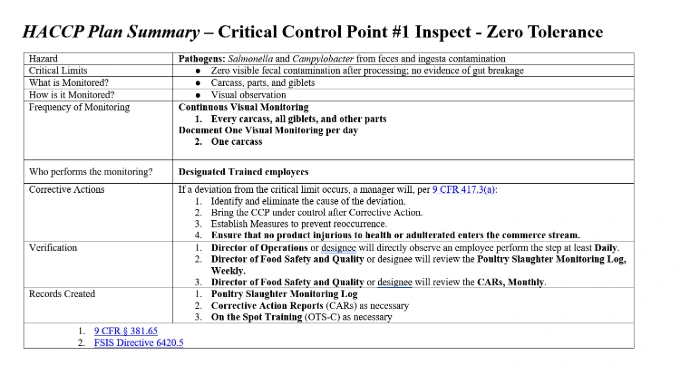
A CCP must be monitored, verified, and proven with records.
There are no comments for now.
to be the first to leave a comment.